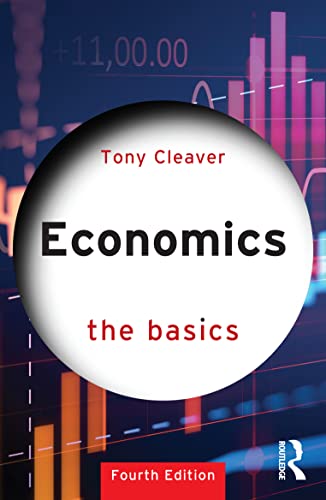
Economics: The Basics / Tony Cleaver.
Material type: TextSeries: Economics handbook series (McGraw-Hill Book Company)Publisher: Abingdon, Oxon; Routledge, 2023Description: 300 pages ; illustration, 20 cmContent type:
 - text
- unmediated
- volume
- 9781032472812
- 23 330 c.t.e
| Item type | Current library | Call number | Status | Date due | Barcode | Item holds |
|---|---|---|---|---|---|---|
 Books
Books
|
Media and mass communication Library G2 | 330 c.t.e | Available | MA0003348 |
Includes glossary, further reading suggestions, and updated case studies.
An engaging and up-to-date introduction to economics, this fourth edition blends essential theory with real-world events such as the COVID-19 pandemic, the war in Ukraine, financial instability, and digital economy shifts. Designed for newcomers, it includes glossary entries, case studies, and reading guidance to support understanding of core economic dynamics.
This book shows, from start to finish, how microeconomics can and should be used in the analysis of public policy problems. It is an exciting new way to learn microeconomics, motivated by its application to important, real-world issues. Lee Friedman's modern replacement for his influential 1984 work not only brings the issues addressed into the present but develops all intermediate microeconomic theory to make this book accessible to a much wider audience. Friedman offers the microeconomic tools necessary to understand policy analysis of a wide range of matters of public concern--including the recent California electricity crisis, welfare reform, public school finance, global warming, health insurance, day care, tax policies, college loans, and mass transit pricing. These issues are scrutinized through microeconomic models that identify policy strengths, weaknesses, and ideas for improvements. Each chapter begins with explanations of several fundamental microeconomic principles and then develops models that use and probe them in analyzing specific public policies. The book has two primary and complementary goals. One is to develop skills of economic policy analysis: to design, predict the effects of, and evaluate public policies. The other is to develop a deep understanding of microeconomics as an analytic tool for application--its strengths and extensions into such advanced techniques as general equilibrium models and pricing methods for natural monopolies and its weaknesses, such as behavioral inconsistencies with utility-maximization models and its limits in comparing institutional alternatives. The result is an invaluable professional and academic reference, one whose clear explanation of principles and analytic techniques, and wealth of constructive applications, will ensure it a prominent place not only on the bookshelves but also on the desks of students and professionals alike
There are no comments on this title.